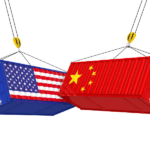


In the twilight of an era dominated by American economic supremacy, a storm brews over the Pacific. The world watches as the 47th President of the United States, in a fit of economic nationalism, delivers his decree: a blanket 20% tariff on all imports, a crushing 25% levy on foreign automobiles. The repercussions are instant, the message unmistakable—America, the self-proclaimed bastion of free enterprise, has turned inward.
Yet, amid the orchestrated chaos of Washington’s grand maneuver, something remarkable is happening. Across the ocean, old adversaries are setting aside their differences. The shadows of history—bitter war, occupation, and enmity—are momentarily eclipsed by an urgent need for survival. China, Japan, and South Korea, the titans of East Asia, gather in an unprecedented display of unity. The objective: to forge a new economic order, one unshackled from the capricious dictates of Washington.
For decades, the United States played the role of kingmaker in the Far East. Japan and South Korea, staunch allies of the West, stood as bulwarks against Beijing’s ambitions. Their economies thrived under an American aegis, their industries flourished under the protective umbrella of Washington’s military might. But now, with a stroke of a pen and the proclamation of a so-called “Liberation Day,” the President has shattered that carefully constructed reality. In one fell swoop, he has made the cost of loyalty unbearable.
The meeting in Seoul is brief but historic. Wang Wentao, China’s formidable Minister of Commerce, sits across from Ahn Duk-geun, South Korea’s Minister of Industry, and Yoji Muto, Japan’s trade chief. Their statements, drafted in precise, measured tones, conceal a seismic shift beneath their diplomatic veneer. “The global economic landscape is fragmenting,” they announce, their words rippling through the world’s financial centers. “We must build a predictable environment for trade and investment.”
Behind the formalities, the stakes are clear. If America is to turn its back on globalization, Asia must forge ahead alone. For Beijing, the opportunity is unprecedented. Japan and South Korea, long seen as reluctant chess pieces in the game of U.S.-China rivalry, now extend their hands in economic partnership. The weight of historical grievances—Nanjing, colonial rule, forced labor—has not vanished, but it is momentarily eclipsed by a shared crisis.
Yasuji Komiyama, Japan’s Director-General of Trade, addresses the press with a grave candor. “The world around us is shifting,” he declares. “Uncertainty grows.” The implication is obvious: an America that once guaranteed stability is now its greatest source of instability.
And so, as Washington prepares its grand economic war, Asia readies its countermeasure. The corridors of power in Beijing hum with quiet satisfaction. Tokyo and Seoul, ever pragmatic, find themselves in unfamiliar territory—cooperating with an erstwhile rival against their oldest ally. The ink is not yet dry on their trade agreements, but the consequences are already felt. The world economy has entered a new phase, and the balance of power tilts, ever so slightly, toward the East.
For the United States, the tariffs were meant to be a declaration of strength, a rallying cry for a new age of economic dominance. Instead, they may well mark the beginning of its greatest decline. History has turned a page, and in the margins, a new alliance is being written—one that no tariff, no decree, no isolationist fantasy can undo.
The world has changed. And America, for the first time in a century, may no longer be at its center.