
Wars do not begin when we think they do. They do not start with noise, sirens, or headlines screaming urgency. They begin earlier. In the margins. In decisions that seem small, almost invisible, yet quietly alter the course of the world.
One such moment occurred in December.
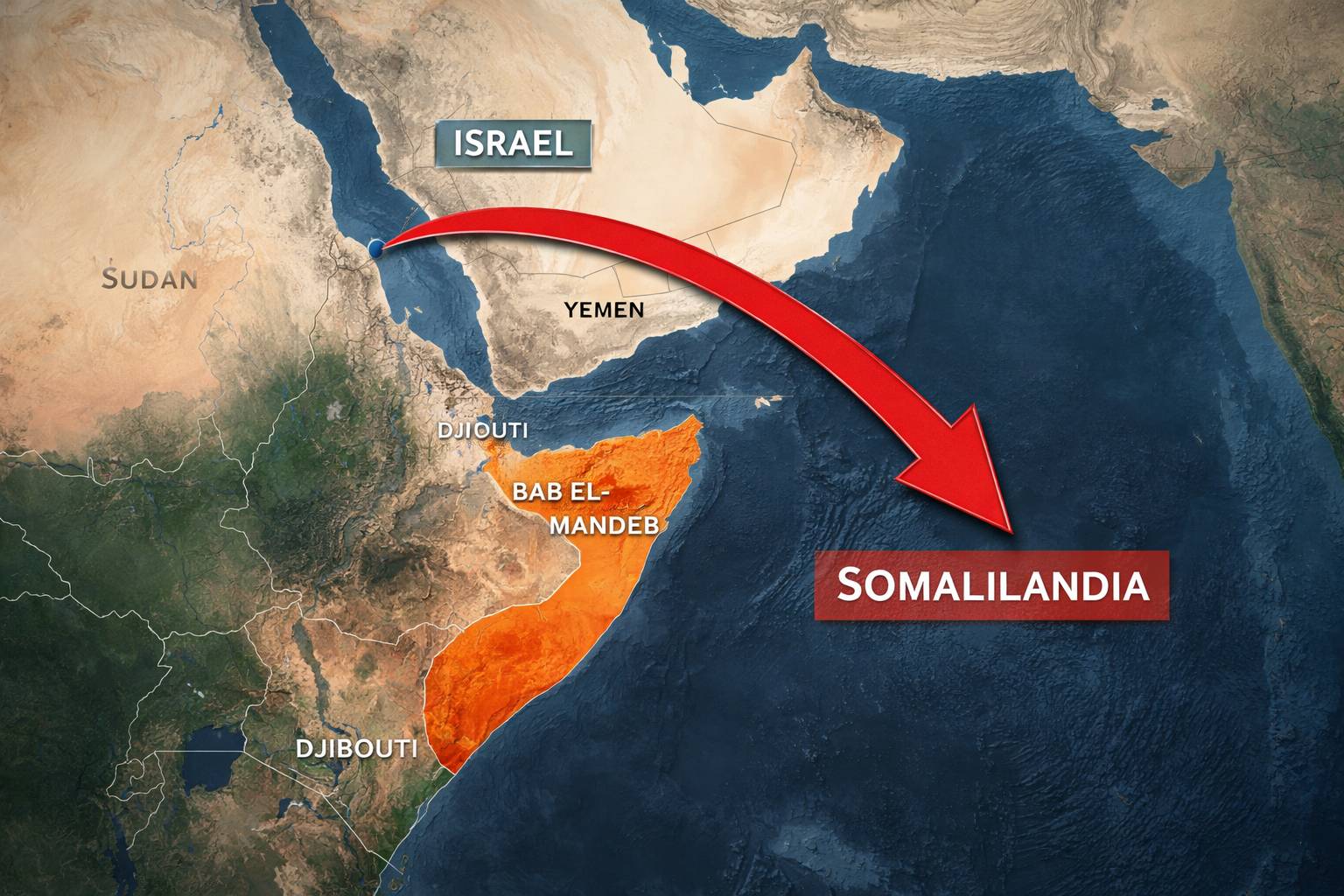
Israel recognized Somaliland as an independent state.
For many, it was just another piece of news, a brief line in distant geopolitics. For Iran, it was not. Tehran reacted with a speed that leaves little room for doubt. It understood what others had not yet seen: this was not a gesture, it was a move. And not a minor one.
Because the real stage is not Somaliland. The real stage is the Red Sea.
A space where routes, interests, energy, and power converge. Where global trade breathes, and where every presence matters. To enter that space is not merely to position oneself—it is to declare intent.
And yet, for most of the world, Somaliland remains largely unknown.
A territory of 137,600 square kilometers. Three and a half million people. A name that barely appears in the world’s mental maps. Officially, it is still Somalia. In practice, it is not.
Since 1991, it has existed as a state that no one recognizes, yet one that functions. It has a government, elections, and stability. In a region where instability seems the norm, Somaliland endures. And paradoxically, that endurance is what makes it valuable.
But it is not its politics that makes it a key piece. It is its place in the world.
Somaliland looks toward the Red Sea. And it does so from a privileged position, just a few kilometers from the Bab el-Mandeb Strait. A narrow passage, almost invisible on the map, yet essential to the planet. A decisive share of global trade flows through it—oil, energy, the lifeblood that connects continents.
It is not just a geographic point. It is an artery.
And whoever stands near an artery will, sooner or later, feel the pulse of power.
That is why Israel’s decision cannot be read as a symbolic gesture. It is a door opening—to presence, to influence, to the possibility of observing, intervening, projecting power.
Iran has understood this better than anyone.
Because this is not a direct conflict. It is something more subtle, slower, deeper. A war of positions. A board where each piece moves with precision, aware that the real confrontation is not always visible.
The Red Sea is becoming a new axis. And Somaliland, one of its strategic footholds.
But amid this geopolitical game, there is a reality that must not be forgotten.
Somaliland is not just a strategic space. It is a territory seeking recognition, stability, and a future. It sees in this growing international attention an opportunity—and perhaps also a promise.
The problem is that, in geopolitics, promises are rarely innocent.
History is filled with places that, once they became important, ceased to be peaceful. Territories that, once they entered the radar of major powers, lost control over their own destiny.
The Horn of Africa knows that history well.
And now, once again, the world seems to be drawing closer—without making a sound.
The wars of today are not announced. They are suggested. Prepared in silence, far from the spotlight.
And perhaps, while we are looking elsewhere, one of them has already begun.
There.
In Somaliland.